
This Place Must Last Forever: A Visit to Mu Monastery
May 19, 2026By Jean Shields Fleming
Just before arriving at Mu Monastery, some 12,000 feet in the sky, just shy of the Tibet border, walking up a long traverse, suddenly something speeds downhill directly at us. A man. On a small horse. Dust trails him, stirred by hooves. In his traditional clothes he could be galloping out of another century, perhaps another eon altogether.
But no. It’s 2026. This is just the magic of Mu starting to work on us pilgrims.
He draws the horse to a sharp stop, dismounts, and offers himself to the teacher we’re traveling with, Geshe Tenzin Zopa. After Geshe-la blesses him, he remounts and continues on. As do we. Up, up, and more up.
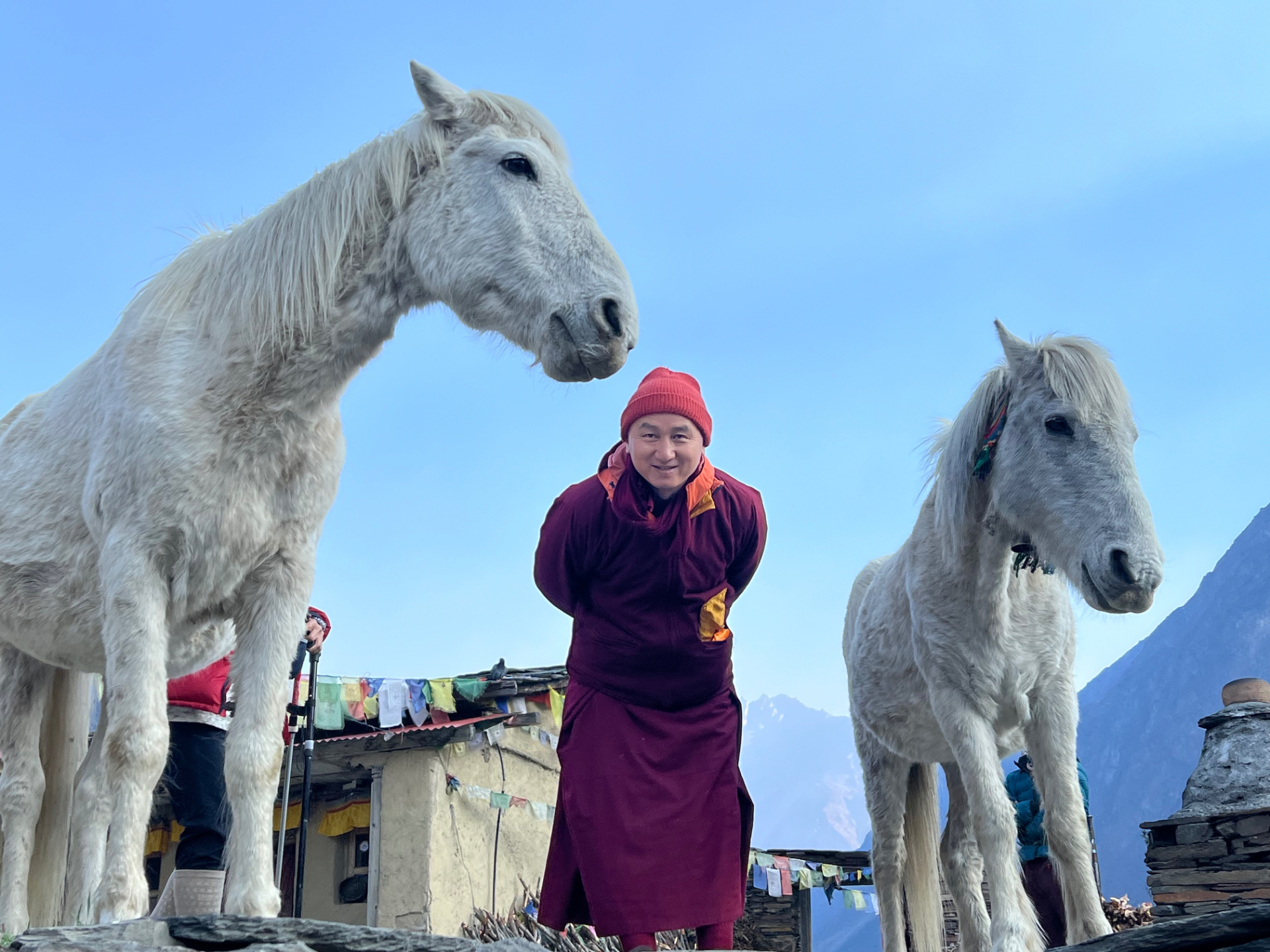
Geshe Tenzin Zopa at Mu Monastery, Tsum Valley, 2026.
You couldn’t call this a road, per se. Not in our modern asphalt-and-white-lines sense of the word. Yet on this same path, we join a continuous stream of travel: traders laden with goods and nomads herding yaks. Now us, with our water bottles and camera phones. In the last 100 years, monks from Tibet arrived. Because, as Geshe-la explains, this land was recognized by fully realized, omniscient beings as a repository, a place consecrated to house relics and holy objects, countless treasures of the Dharma.
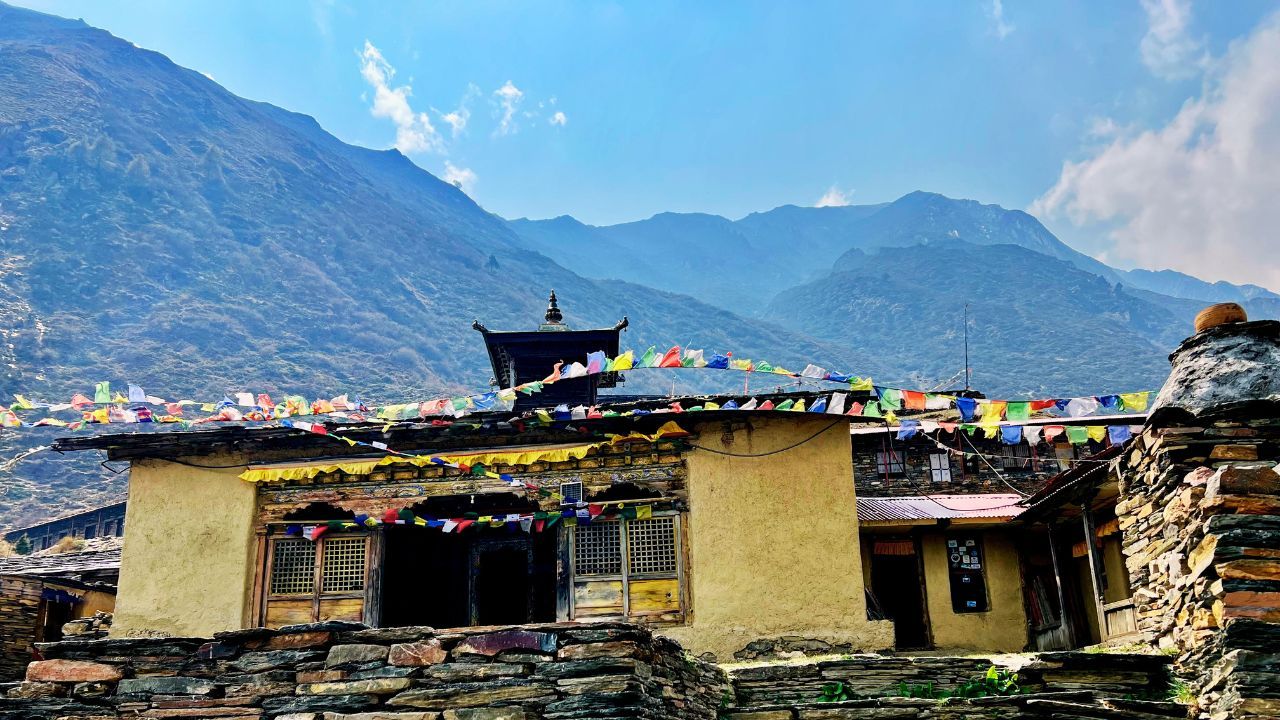
It’s hard to see the sacred geometry at first glance. Heavy stone roofs buckle under their own weight, aided by wind and weather. Evidence of water damage is everywhere – along the ceiling lines, then pouring down the wallboards, dry tributaries edged in mold. An austere place quickly falling into decrepitude. That’s what my unenlightened eyes behold.
Until we go into the gompa. Dense with devotion, a century’s worth of prayer filters the light. The floor planks are smoothed to a sheen by all the prostrations. Saffron colored wool rugs invite us to sit and meditate. The bright blue Medicine Buddha sends forth healing. A collection of old trunks gathers dust on one side, while on the other, hundreds of Tsa tsas, small plaster figurines, line the wall. All Chenrezigs, each with 1000 arms, they bless us with boundless compassion. At the front, amid photos of beloved gurus, the “Self-Spoken” Tara peers out from behind a veil, curious, intent, focused. This statue has been known to speak directly to supplicants, and she certainly looks to be taking it all in. Our hope, pain, aspiration – it’s nothing she hasn’t seen before. Yet she will work tirelessly on our behalf. All we have to do is ask.
Over tea, a monk tells me about life at Mu. He came when he was 19. That was 55 years ago. There were more monks then, he says. Now, he’s one of three in residence. During the season, they get a trickle of visitors. Tsum Valley, where we are, is not a major trekking route, yet. And Mu’s altitude puts it out of reach for many. So anyone who comes is most welcome. During the winter he saw – and heard – many snow leopards. Fierce, elusive, the animals are regarded as protectors of sacred sites and you’ll find them painted onto devotional thangkas or carved onto the base of stupas. These leopards, he tells me, always move along the ridge beyond the monastery, never crossing the courtyard or using the pathways.
The next day we shift fully into metaphor mode. Those unassuming trunks in the gompa? Turns out, they hold relics. Unbelievable blessings. But the keys to open them can’t be found. Perhaps our karma, that had brought us so far, was petering out at last. And that would be ok.
Over and over, Geshe-la has reinforced that simply being here is the blessing. Whether we see or don’t see a relic, meditate in a cave or not, we are blessed just the same. Nothing depends on sight. All depends on faith in the merit of the gurus.
The keys appear, the trunks unlock and we are amazed by the beauty they hold. Holy objects, some over 600 years old, thick with reverence. We add ours.
“This place must last forever. As long as the earth lasts, this place must last.”
— Geshe Tenzin Zopa
“It doesn’t matter that there aren’t lots of people here,” Geshe-la says later when we ask about the prognosis for this spectacular yet improbable place. “Or that there are only a few monks. As the times become more degenerated, so these material manifestations of blessing become more significant to stay alive.” He pauses here, and wipes his eyes. “This place must last forever,” he tells us. “As long as the earth lasts, this place must last.”
That’s the work, he says. And forever starts today.
Now, about that roof. Let’s begin there.
The Restoration Project
Be Part of the Restoration of a Hidden Himalayan Gem.
View the Mu Monastery Project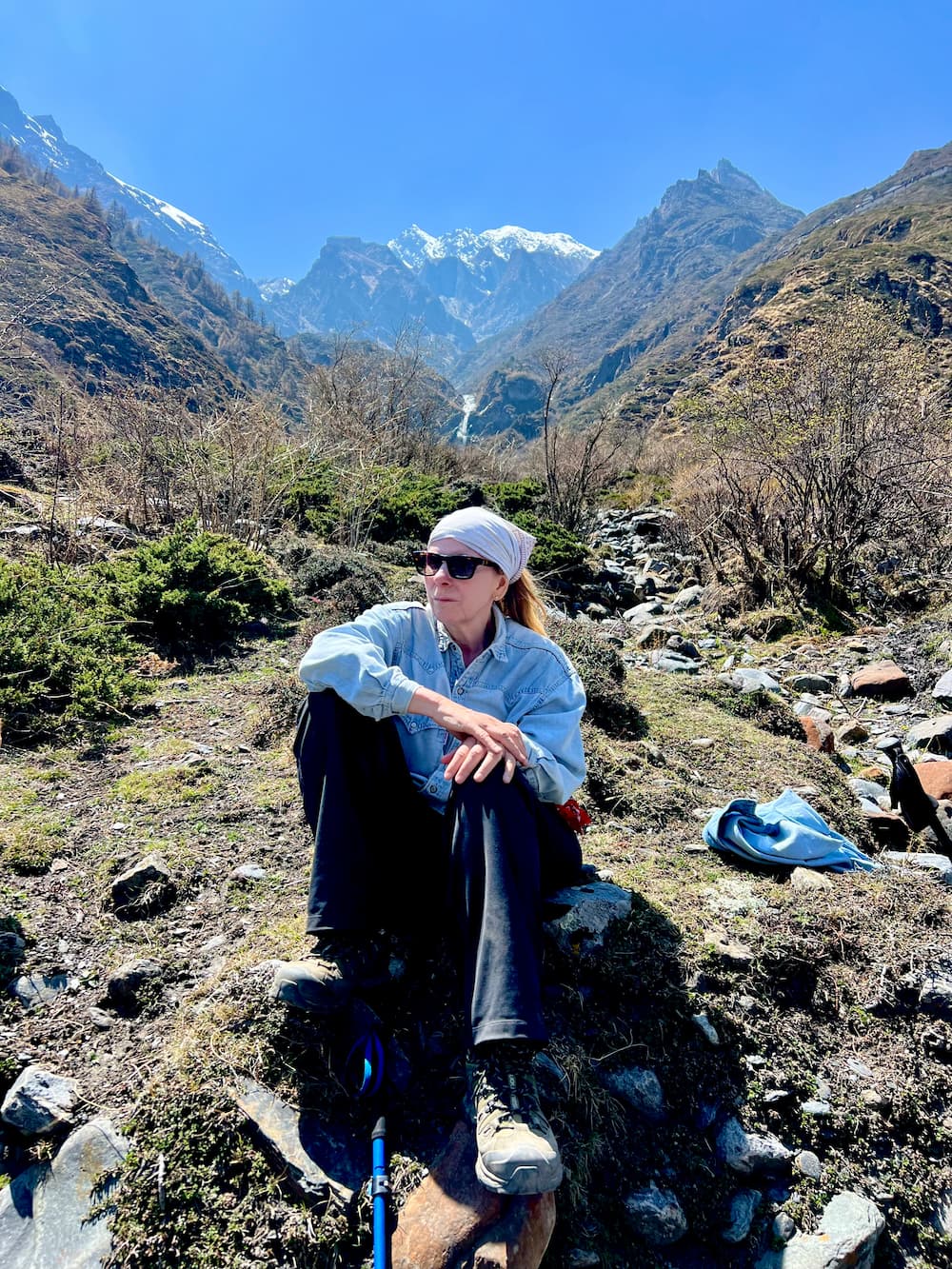
Jean Shields Fleming is a writer based in Greece. She is the founder and editor of Certain Age Magazine, and took part in the 2026 Gradual Path Tsum Valley pilgrimage.
Stay connected with news and updates!
Join our mailing list to receive the latest news and updates from our team.
Don't worry, your information will not be shared.
We hate SPAM. We will never sell your information, for any reason.


